
Clinical Insights
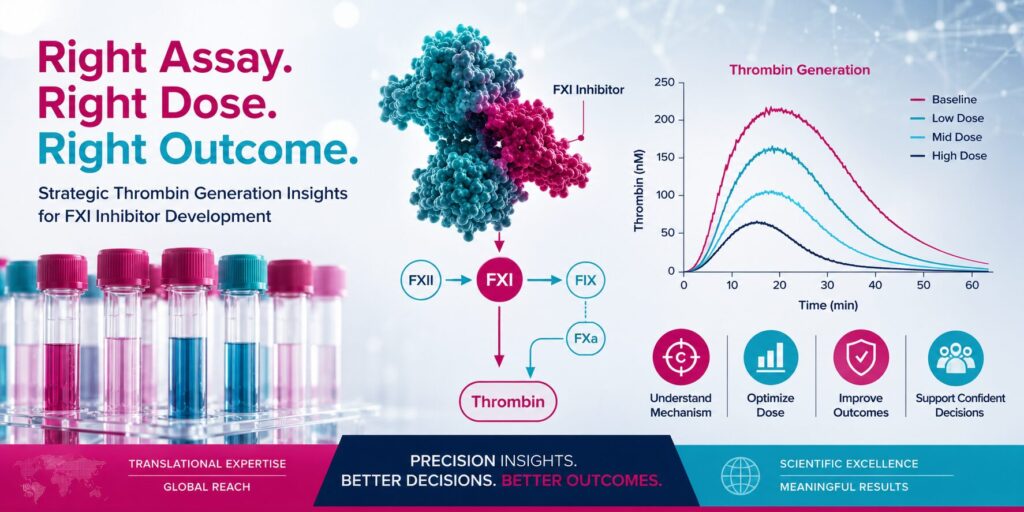
Translational Lab Spotlight: FXI Inhibitors & Thrombin Generation Strategy
Right Assay. Right Dose. Right Outcome.
Thrombin generation FXI inhibitors are transforming anticoagulation development by enabling more precise measurement of coagulation dynamics. With the promise of reducing thrombotic risk while minimizing bleeding complications, FXI-targeted therapies are reshaping how sponsors approach hemostasis, safety, and clinical differentiation.
But alongside this opportunity comes a fundamental challenge:
How do you measure what matters – accurately, reproducibly, and at the right stage of development?
This is where translational strategy – and the right laboratory partner – becomes critical.
The Challenge: Measuring a Subtle Mechanism
Unlike traditional anticoagulants, FXI inhibitors operate within a more nuanced part of the coagulation cascade. Their effects are not always fully captured by conventional coagulation assays such as aPTT or PT.
As a result, sponsors face key questions:
- Which assays best reflect pharmacodynamic activity?
- How do you differentiate signal from noise in early-phase studies?
- How can assay data meaningfully inform dose selection?
Answering these questions requires more than technical execution. It requires a translational framework that connects assay selection to clinical decision-making.
Why Thrombin Generation Matters
Thrombin generation assays (TGA) have emerged as a powerful tool in FXI inhibitor development because they provide a global, functional view of coagulation.
Rather than measuring a single point in the cascade, TGA captures:
- Lag time (initiation)
- Peak thrombin (amplitude)
- Endogenous thrombin potential (overall capacity)
This broader perspective allows sponsors to:
- Better understand drug mechanism
- Differentiate compounds
- Support dose-response modeling
However, TGA is not a one-size-fits-all solution.
Its sensitivity depends heavily on:
- Reagent selection
- Trigger conditions
- Sample handling
- Analytical standardization
Without careful optimization, results can vary – and mislead.
The Translational Gap: From Assay to Action
A common pitfall in FXI programs is treating assays as isolated data points rather than decision-enabling tools.
For example:
- An assay may show activity – but is it clinically meaningful?
- A biomarker may shift – but does it correlate with reduced thrombotic risk?
- A dose may look promising – but is it optimized?
Closing this gap requires integrating:
- Scientific expertise
- Operational rigor
- Cross-assay strategy
This is where a dedicated translational lab approach becomes essential.
A well-designed thrombin generation FXI inhibitors strategy ensures that assay outputs are not just measured, but translated into meaningful development decisions.
MLM’s Approach:
Right Assay. Right Dose. Right Outcome.
At MLM Medical Labs, our Translational Lab is designed to align assay strategy with development goals, particularly in complex areas like FXI inhibition.
Our approach focuses on three principles:
1. Right Assay
We guide assay selection based on mechanism, indication, and study phase, leveraging thrombin generation assays alongside complementary coagulation and biomarker strategies.
2. Right Dose
By integrating functional data with pharmacokinetics and clinical endpoints, we help sponsors better define dose-response relationships and reduce uncertainty in early-phase trials.
3. Right Outcome
Ultimately, our goal is to ensure that laboratory data drives confident decisions, supporting both safety and efficacy outcomes.
Timing Is Everything
As FXI inhibitors continue to advance across multiple indications, the need for robust, scalable, and interpretable assay strategies has never been greater.
Early investment in a thrombin generation FXI inhibitors approach can:
- Reduce development risk
- Accelerate timelines
- Strengthen regulatory positioning
Moving Forward
The future of anticoagulation is not just about new targets – it is about better measurement and smarter decisions.
FXI inhibitors offer enormous potential. Realizing that potential depends on choosing the right tools and applying them with purpose.
Because in translational science, success comes down to three things: Right assay. Right dose. Right outcome.