
Clinical Insights
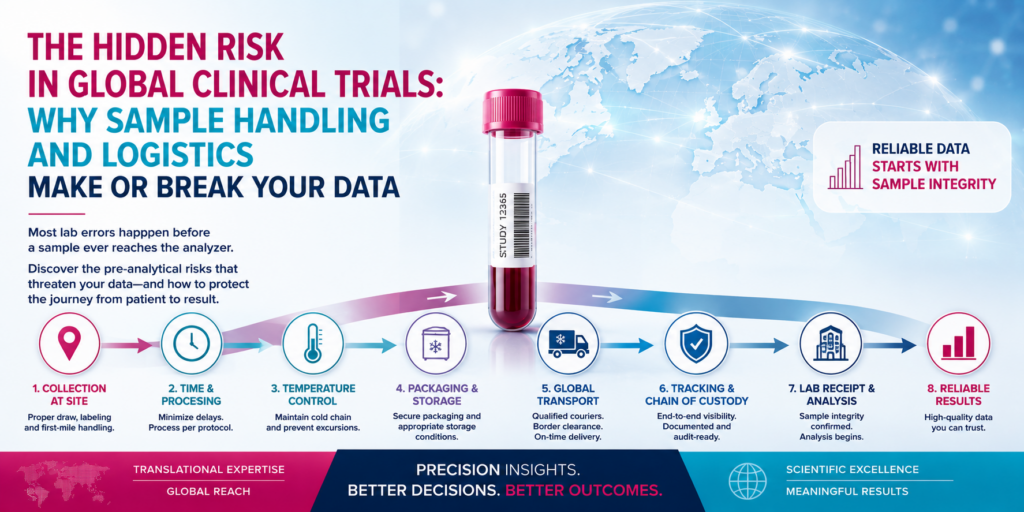
The Hidden Risk in Global Clinical Trials:
Why Sample Handling and Logistics Make or Break Your Data
An estimated 46 to 68 percent of all laboratory testing errors happen before a sample ever reaches an analyzer. That figure, drawn from preanalytical-error research, should reframe how you weigh clinical trial sample handling and logistics: the assay gets the scrutiny and the budget, but most of what goes wrong is already locked in by the time the sample is measured.
No matter how sensitive your platform, a compromised sample produces compromised data. In a global trial, the journey from patient to result crosses sites, borders, couriers, and freezers. That journey is the most fragile link in the whole chain, and it is the one your selection process examines least.
The hard part is no longer choosing the assay. It is keeping the sample intact and provable across every site, every border, and every year it sits in storage. This piece walks the sample’s journey step by step, names the specific points where trial data quietly breaks before anyone runs a test, and gives you the questions that expose those points at vendor selection.
Sample handling, not the assay, is where trial data is won or lost
Ask the industry’s own quality experts where the biggest data risk in clinical trial sample handling and logistics lives, and they do not point at the analyzer. They point before it. The 46-to-68-percent preanalytical-error estimate, echoed by clinical scientific-affairs leads who study specimen quality, locates the dominant source of unreliable lab data in collection, transport, processing, and storage, not in the measurement itself. The most advanced assay cannot rescue a sample that was already compromised before it arrived.
Variability enters at every step of that journey. A processing delay at a busy site, a temperature excursion in a customs queue, an inconsistent handling protocol between two regions, a gap in visibility while a shipment is in transit: each one nudges a biomarker away from its true value. Individually they look minor. Stacked across a multi-site, multi-year trial, they become the noise that buries a real treatment effect.
The stakes are not academic. Many trial specimens (timed pharmacokinetic draws, rare-disease samples, tumor biopsies) cannot be redrawn if they are lost or degraded in transit, and industry commentary puts the exposure from a single major logistics failure at months of delay and millions in cost, on top of the direct price of retesting and replacement.
Consider a parallel from measurement science. A nationwide five-year study of breast cancer biomarker testing found estrogen-receptor positivity ranging from 84.2 to 97.6 percent across 29 laboratories, and each lab’s treatment rates tracked its own positivity rate. That is an illustrative analogy about assay variability rather than a pre-analytical-handling figure, but the lesson transfers cleanly: when measurement drifts, real clinical and analytical decisions drift with it. The sample’s journey starts at the first mile, and so does the risk.
First-mile risk: the collection-to-processing window where data quietly breaks
The first mile is the least controlled phase of the entire chain. Site experience, staffing, and infrastructure vary widely, and a delay of only a few hours between draw and centrifugation can silently degrade specific analytes while others in the same tube look untouched. This is where a trial can carry compliant-looking overall logistics and a biomarker-specific integrity problem at the same time.
The numbers make the risk concrete. In a SOMAscan study of 1,305 plasma proteins, whole blood held six hours at 0 degrees Celsius shifted 148 proteins (11 percent), and low-force centrifugation alone moved 200 proteins (15 percent) through complement activation. In blood-based neurodegeneration markers, plasma amyloid-beta 40 and 42 fell significantly after a 24-hour processing delay and a single freeze-thaw cycle, while p-tau181 rose measurably at 24, 48, and 72 hours. A field study of nutrition and non-communicable-disease markers found creatinine deviated 14.6 percent, hemoglobin 16.4 percent, and erythrocyte folate 33.6 percent after 12 hours at 22 to 30 degrees, while albumin, CRP, glucose, lipids, and HbA1c held stable to 24 hours.
Read those three studies together and a pattern emerges: fragile and stable analytes live in the same tube, so pre-analytical variability is analyte-specific, not sample-specific. That reframes the operational question entirely. “How fast do you need to process” is the wrong question. “Which analytes in this panel are fragile, and what is the collection-to-centrifugation window for each” is the right one, and it matches the risk-based philosophy that ICH E6(R3) now expects.
Answering that question is where standardized first-mile control earns its place. MLM builds protocol-specific kits in its proprietary MLM Kit Manager, with pre-labeled tubes assembled by teams in Monchengladbach and Memphis that ship more than 100,000 kits worldwide each year, so every site collects into the same validated materials. MLM offers two point-of-collection requisition options. Its own e-Requisition solution, built into mlm online® at no additional cost, lets sites capture and submit sample and visit data digitally from any phone, tablet, or computer, guiding staff through the required and protocol-specific fields so that missing subject IDs, absent collection times, and illegible handwriting stop generating follow-up queries. For studies that want a more robust layer, a TruLab partnership adds advanced point-of-collection tracking on top. Either way, the requisition is captured digitally and reconciled at the source rather than on paper. The full stack sits on MLM’s electronic requisition and sample management and logistics pages.
Before you sign, ask any vendor which analytes in your specific panel are fragile, and what their written collection-to-centrifugation SOP requires.
When the biology will not wait: PBMC and cell-based endpoints
Some endpoints do not degrade gracefully. They fall off a cliff. Cell-based immune endpoints that depend on live peripheral blood mononuclear cells have a hard viability threshold, and in multi-site trials where 24-plus-hour transit is common, that threshold is crossed routinely. The optimal processing window depends on the study. For vaccine and infectious-disease work it can be as tight as 4 to 6 hours from venipuncture, for immuno-oncology it sits around 8 hours, and some assays hold up to 24 hours when blood is drawn into tubes with preservatives. Across most live-cell endpoints the working target is under eight hours, which most courier-dependent site networks cannot hit on their own.
The functional cost of delay is measurable and severe. Delayed isolation at 20 or more hours post-draw, versus 6 or fewer, dropped post-isolation viability from 95.8 to 91.0 percent, cut post-thaw viability from 98.0 to 94.0 percent, and pushed the survival-through-thaw ratio from 0.7 to 0.3, roughly a 40 percent cell loss. Worse for immuno-oncology work, natural-killer-cell apoptosis climbed from 23.8 to 41.0 percent and antibody-dependent cytotoxicity fell from 53.0 to 27.1 percent.
Beyond about 24 hours, NK cells, B-cells, monocytes, and dendritic cells deteriorate far faster than T-cells. A site with a longer courier leg will systematically undercount non-T-cell immune activity, turning a logistics artifact into what looks like a biological signal.
The fix is to design around the biology rather than hope the couriers cooperate: target sub-eight-hour processing, and favor sites near a processing lab or with on-site capability. This is a differentiator most vendors skip over, and one MLM can speak to specifically. MLM’s global PBMC service reports greater than 95 percent initial viability and greater than 80 percent post-thaw viability with a five-hour processing window, backed by flow cytometry on either a 14-color BD FACSLyric or a 20-color Cytek full-spectrum system, chosen to fit the panel, for immunophenotyping, immuno-oncology, and CAR-T work. If your endpoints ride on live cells, processing proximity is a protocol decision, not a courier detail.
Cold chain and global logistics: keeping samples intact at scale
Every border a sample crosses multiplies the ways it can fail. Long transport legs, multiple handoffs, strict temperature windows, and customs or import holds each add a point where the cold chain can break, and the causes are mundane: weather delays, clearance queues, equipment failure, human error, inadequate packaging. FDA and EMA both require an unbroken, provable cold chain for the underlying trial data to be considered valid, so a single undocumented excursion can invalidate results that took months and irreplaceable specimens to generate.
What good looks like is not mysterious. It is validated temperature-controlled packaging, continuous monitoring across the journey, disciplined dry-ice and refrigerant management, contingency plans for the predictable failures, and customs documentation (biological-material declarations, import permissions, dry-ice rules) prepared before the first shipment leaves a site rather than scrambled together once a shipment is held. Good vendors also track the journey by number: on-time delivery rate, temperature-compliance rate, and exception-resolution time, so a held or excursed shipment is caught and documented rather than discovered at receipt.
MLM brings concrete proof points here rather than promises. The patented MLM Safeguard Box is a smart ambient-shipment system validated against both minus-30-degree cold stress and 50-degree heat stress, each for three hours within a 24-hour cycle, simulating real overnight courier conditions, and it is reusable after cleaning. Centralized kit distribution and a wholly owned North America, Europe, and Africa network remove handoffs that a multi-vendor patchwork cannot.
In Sub-Saharan Africa, in-region next-generation sequencing through Cytespace removes the offshore-shipment leg entirely for that assay class, which shortens turnaround qualitatively even though MLM publishes no specific day-count figure. You can read the regional detail on the Cytespace Africa page. The practical contrast is simple: an owned network shortens the custody chain, while a stitched-together vendor list lengthens it at every seam.
Chain of custody and data integrity: proving the sample is what you say it is
Here is the question inspectors actually ask: can you prove this sample is what your records say it is, at every point from draw to result? Chain of custody has moved from a documentation nicety to a foundational data-integrity requirement. Every biological sample now needs a documented, continuous chain from collection through receipt, and inspectors review audit trails, electronic-record controls, and custody documentation against the ALCOA+ framework (attributable, legible, contemporaneous, original, accurate, complete, and more). GCLP audits specifically cover receipt, shipment, and storage, and the MHRA flagged clinical-trial-sample laboratory systems as a 2025 inspection focus.
Delegation does not dilute your accountability. Under ICH E6(R3), finalized in January 2025, made effective by EMA on July 23, 2025, and adopted by FDA in September 2025, you may delegate sample logistics to a vendor, but you cannot delegate the accountability for how that vendor performs. The guideline pushes sponsors to name logistics and lab vendors explicitly as Critical-to-Quality factors and to show proportionate, documented oversight rather than treating handling as an assumed background service.
A gap in that chain is not a paperwork nuisance. It is a data-integrity finding that can put the affected results, and the submission resting on them, in question.
MLM’s systems are built to produce that proof on demand. mlm online® provides real-time temperature monitoring across all locations and freezers, with alerts routed to a 24/7 response center, per-sample freeze-thaw cycle counts, 21 CFR Part 11-compliant role-based logins for CRAs, investigators, and sponsors, and barcode-level sample tracking. Point-of-collection custody flows in real time into that portal through MLM’s e-Requisition solution, with a more robust TruLab layer available for studies that need it. When you evaluate a vendor, ask them to show the live custody and temperature record for your single hardest-to-reach site, not a demo from an easy one.
Biostorage and long-term sample integrity
Samples outlive the patient visit, sometimes by decades, and that is where storage stops being a warehouse line item. A global trial generates large specimen volumes that must stay viable, traceable, and audit-ready for years of planned and exploratory analysis. Integrity, rapid retrieval, and accurate tracking all get harder as volume grows, and every unplanned freeze-thaw cycle chips away at the very analytes the earlier sections worked to protect. The freeze-thaw discipline that matters at collection matters just as much across years in a freezer.
This is where per-sample tracking earns its keep years later. mlm online® logs freeze-thaw cycle counts for each stored sample, so a specimen retrieved for exploratory analysis carries a documented handling history rather than a guess about how many times it has been thawed.
MLM’s biostorage spans the full temperature range: ambient, minus-20 and minus-30, minus-70 and minus-80 degrees, and liquid nitrogen, across its European, North American, and South African sites, with retention beyond 20 years under a GCLP, CLIA, CAP, ISO, and 21 CFR Part 11-compliant chain of custody. The Cytespace acquisition added expanded controlled and ultra-low-temperature freezer capacity to the African node, described here in general terms because MLM has not published the specific temperature range or backup-power configuration for that expansion. Treated correctly, storage is not a warehouse cost. It is chain of custody extended over years, and it should be scored that way.
The ownership question: one quality system versus a stitched-together network
Notice where every risk in this article concentrates. First-mile variability, cold-chain excursions, custody gaps, and storage drift all cluster at the same structural point: the seam where two organizations meet. Each partner boundary in a sample’s journey is a place where methods, reference ranges, SOPs, and accountability can quietly diverge. The most reliable way to reduce handling risk is to reduce the number of seams the sample crosses.
That is the case for a wholly owned network under one quality management system. MLM runs its North American and European safety labs on harmonized analytical platforms (including the cobas 6000), harmonized reference ranges, and a single QMS and SOP set, processing thousands of samples per week, and cites 100 percent comparability of data across those labs as the outcome. The June 1, 2025 acquisition of Cytespace Africa, a wholly owned acquisition rather than an affiliate arrangement, extends that same accountability structure to the African leg instead of introducing a new partner seam, giving one harmonized operation across Europe, North America, and Sub-Saharan Africa. For the neuro-specific version of this logistics argument, see the companion piece on the seven criteria that predict CNS data quality.
Consolidating clinical trial sample handling and logistics, testing, and biostorage inside one accountable owned network is what turns sample handling from a liability into an advantage. You get more comparable data across regions, less rework, fewer duplicate queries, a cleaner submission, and one entity to answer to a regulator when E6(R3) oversight questions arrive. Pressure-test your own sample-handling chain against the risks in this article: the first-mile window, the PBMC viability cliff, the cold-chain seams, the custody record, and the storage plan. Then bring the hardest link to MLM’s sample management and logistics team and ask them to defend it with you.
Frequently Asked Questions
How much processing delay can a blood sample tolerate before biomarker data becomes unreliable?
It depends entirely on the analyte, not on a single universal cutoff. Stable markers such as albumin, CRP, glucose, lipids, and HbA1c hold for up to 24 hours at moderate temperatures, while creatinine, hemoglobin, folate, amyloid-beta, and several inflammatory cytokines degrade measurably within 6 to 24 hours. The right question is not how fast you can process, but which analytes in your specific panel are fragile.
Does using a central lab or logistics vendor also outsource regulatory accountability?
No. Under ICH E6(R3), effective at EMA in July 2025 and adopted by FDA in September 2025, you may delegate sample logistics and central-lab tasks to a vendor, but accountability for the outcome stays with you. The guideline actually tightens expectations, asking sponsors to name logistics and lab vendors as Critical-to-Quality factors and to document proportionate, ongoing oversight rather than treating the handoff as the end of their responsibility.
What is the difference between a wholly owned lab network and an affiliate network for data comparability?
A wholly owned, single-QMS network runs harmonized SOPs, analytical platforms, and reference ranges across every site, which is what lets data compare cleanly at database lock. An affiliate network stitches together partners that may each run their own methods and reference ranges, introducing drift at every boundary. MLM cites 100 percent comparability of data across its North American and European safety labs as the result of that harmonization.
How do you protect irreplaceable samples, such as rare-disease specimens, in transit?
You combine three controls: continuous point-of-collection chain of custody (captured digitally through MLM’s e-Requisition solution in mlm online®, with a more robust TruLab option available), validated temperature-controlled packaging such as the patented MLM Safeguard Box, and real-time temperature monitoring with 24/7 alerting through the mlm online® portal. Because rare-disease and timed samples generally cannot be redrawn, the priority is provable custody and monitored conditions from the moment of collection, not just at receipt.
Why does in-region testing, for example in Africa, matter versus shipping samples out?
In-region testing removes the offshore-shipment leg entirely for that assay class, eliminating the customs holds, transit time, and cold-chain exposure that a cross-border journey adds. MLM frames its in-region next-generation sequencing through Cytespace as removing the old trade-off between advanced genomic testing and trial speed. The benefit is real and stated qualitatively, since MLM has not published a specific days-saved figure.